Baur Sets the Bar High
The territory of Alsace has traded hands between France and Germany for centuries, resulting in a beautifully unique mix of cultures. When it comes to wine, the influence of both is evident — the German influence in the prominence of Riesling, the French influence in the maddeningly complex appellation rules, which, much like the French language itself, are rife with exceptions.
Here's one worth paying attention to: In Alsace, if a label says Riesling or Pinot Gris, it is what it says it is. But when it’s labeled Pinot Blanc… that’s where it gets murky. That designation legally permits a blend of any Pinot varieties — Pinot Blanc, Gris, Auxerrois, even Pinot Noir — and over time, "Alsace Pinot Blanc" became ambiguous for consumers at best, and a loophole to exploit into a dumping ground for high-yield vineyards at worst.
Which is why Thomas Baur’s Pinot Blanc is quietly his most intriguing wine; he’s setting the bar high, and making a Pinot Blanc that is actually 100% Pinot Blanc — with all the markers of quality you’ll find in all his top wines; farmed organically, from a specific plot, at low yields.
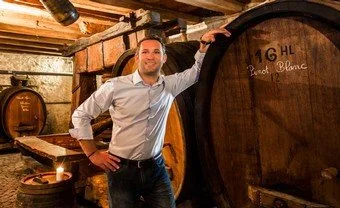
You probably have had one of Thomas’s wine by now. A 9th generation winemaker from Turckheim, one of the most meticulous and enthusiastic producers we work with. Thomas makes a dizzying array of wines, as well as a number of Marc and eau-de-vie — if you ever stop into the Turckheim winery, give yourself the whole afternoon for a tasting. While his Rieslings are undoubtedly the most sough after and iconic of his wines, and his Crémant is a bubble-packed bottle of joy, his Pinot Blanc might just be the unsung hero of the range.
Vins François Baur
Pinot Blanc 2024
We’ve been bringing in Baur’s Pinot Blanc for years, because we knew the moment we tasted it how seriously Thomas considered the grape. Most of Thomas's Pinot Blanc fruit goes into his Crémant, but one small vineyard plot — grown on schist, farmed to low yields — stands above the rest, and each year he sets it aside for a single still bottling.
The result is generous and extroverted from the first pour — peach, apple and floral notes, with a lively acidity and a dry, cleansing finish. Aromatically gorgeous and delicately luscious, with enough presence to hold its own at the table but enough freshness to be endlessly easy to reach for. The perfect companion for an impromptu picnic, a potluck, a salad, a quiche, or a plate of fried chicken. Basically, whatever you've got going on.