Less is More: Delaunay Clos Paradis
I spent my college years studying design and architecture, which meant long hours developing ideas into meaningful responses, and trying to making something beautiful. One trap we students constantly fell into was a tendency toward unnecessary complexity. Trying to stand out and put our creativity on display, we would add more and more to our designs. "I just want to make this interesting,” we would explain.
This was met with skepticism by our professors, with one particular response a piece of wisdom that has stayed with me ever since:
"Make it good. That will be interesting."
The message was clear: beauty is not about being flashy, or how elaborate your design is. Good design is achieved by getting the fundamentals right. Everything else follows.
And that's exactly what I think about when I taste Florent Delaunay's Muscadet.
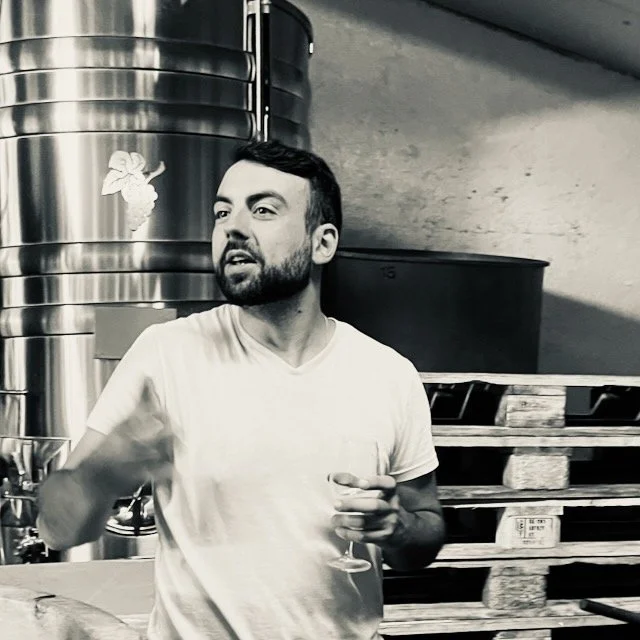
If you know anything about Muscadet, you know it's made from the Melon de Bourgogne grape, and that finding a good one is like searching for a needle in a haystack. More AOC Muscadet-Sèvre et Maine is produced annually than any other appellation in the entire Loire Valley — and there is a lot of wine made in the Loire Valley. Most of it is made on an industrial scale, farmed for volume, reliant on chemical treatments, and vinified in huge tank farms. The result is a bland, characterless liquid that gave Muscadet a well-earned reputation for being “uninteresting.”
Florent started from a different premise entirely: get the fundamentals right. When he took over the family estate, he converted to organic farming and reduced yields. Rather than maximizing volume, he focused on individual parcels and what made each one distinct. Instead of racing to get the vintage to market, he insists on long aging on the lees — even in a market that rewards speed. If you’re indoctrinated in the Cru ethos already, this doesn’t sound radical, but in Muscadet, it's nearly revolutionary.
Muscadet has never been a flashy or bombastic wine, but in the right hands — Florent's, for instance — it is a quintessential food wine: precise, refreshing, and flattering of everything on the table. He was clearly guided by that same advice to make it good. That turned out to be interesting enough.
If you were to try one new wine this summer, make it this one. A refreshing, light-on-its-feet white that will sit comfortably alongside anything you're cooking — and appropriately called Clos Paradis.
Domaine Delaunay
Muscadet Sèvre et Maine
‘Clos Paradis’ 2024
The Clos Paradis is a star among the family's vineyards — a 4 hectare parcel on a well-exposed south-facing slope of schist and quartz soils. Florent holds this wine on its lees for 18 months, twice as long as typical for sur lie aging. Taste the results and you'll understand why his patience is rewarded: a richness and creamy texture reminiscent of fine Chablis, for a fraction of the price.
In the glass, a deep golden hue. On the nose this is perfumed, with autumn apples, Meyer lemon, and ripe stone fruit. On the palate this is pithy, with an elegant sapidity — dense and rich, without the weight. Overall, a layered wine, succulent and substantive, with an edgy and salty finish. Paradise in a glass.